 |
Pan y toros |
|
This material is © Christopher Webber, Blackheath, London, UK. Last updated May 22nd 2001 |
|
First performed at Madrid's Teatro de la Zarzuela on December 22nd 1864, Pan y toros (Bread and bulls - that is, "Bread and Circuses") is in many ways Barbieri's most influential work. El barberillo de Lavapiés (1874) is better loved and much more regularly performed, but Pan y toros marked the coming of age of the romantic three-act zarzuela grande. Picón and Barbieri freed themselves in many essentials here from those French and Italian textual and musical models upon which they and their colleagues had previously relied; and although the plot remains centred on aristocratic intrigue, Pan y toros is a work notable for panoramic social sweep and nationalist fervour as much as for musical originality. |
|
|
|
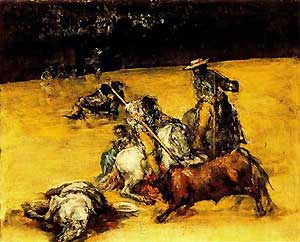
Picón set his story in the early 1790's, the turbulent era of Charles IV so vividly captured in Goya's paintings. The love story of the fictional Princess de Luzán and Captain Peñaranda sets in relief the complex politics at the heart of the zarzuela - namely, the struggle between pro-French Chief Minister Godoy and the patriotic party led by Jovellanos, which culminated in the deposition of Godoy in favour of his rival. Madrid's high and low life are strongly represented, and some vignettes - such as the eerie scenes involving El Hermano del Pecado Mortal ("Brother Mortal Sin") - have powerful dramatic resonance. |

|
The three famous bullfighters, Costillares, Pedro Romero and Pepe-Hillo, are perhaps most interestingly treated of the large dramatis personae. Though bullfighting is seen as a symbol of the decadent state of the nation, the toreros themselves are portrayed as men of the people, whose hearts are very much in the right place. They and some of the other characters are familiar from the canvases of Goya, who himself appears as a highly pro-active supporter of the patriotic opposition, and the text presents a vivid portrait of the capital in a tumultuous era. |
|

|
|
As for the music, although Barbieri still relies as heavily on Italian forms as in the earlier Jugar con fuego (1851) there is a genuine sense of new wine being poured into the old bottles. Spanish popular dance rhythms, melodic turns and harmonies stand out boldly against the stiffer contredances and gavottes associated with the French Ancien Regime. Barbieri's use of melodrama (i.e. spoken dialogue over music) is strikingly effective, and the whole score - alas, too much of it absent from the one available recording - has that fresh energy common to the best of Barbieri's later work. His music for Pan y toros clearly gave Chueca and other composers of the younger generation the confidence to strike out more deeply into the specially Spanish musical terrain that Barbieri had opened up. As a nationalistic work of art, Pan y toros is a considerable achievement in its own right. |


The Pradera [meadow] of San Isidro, by
Goya
 Act 1 -
Madrid, the early 1790's. The Corregidor's Meadow on the banks of the River
Manzanares, with Goya's house and studio in the background. After a
passionate Preludio featuring a reminiscence of the revolutionary
Marseillaise, the curtain rises to reveal an animated crowd of manolos
and manolas, or young madrileños. A family of Blind Beggars cry
for alms, a fake Palmer offers blessings from a plaster-cast footprint of
Christ, street-sellers hawk their wares (No.1: "Hoy fusilan un
soldado"). Though Jovellanos himself has been packed off by Godoy as
ambassador to Russia, to facilitate the planned peace with France which may
mean the end of Spanish independence, the Madrid Corregidor (Magistrate)
remains worried about the increasing activism of the patriotic alliance. He
asks the beggars - whose blindness is a ruse - for news. They tell him that a
consignment of guns has been taken into Goya's house. The influential Royal
mistress Doña Pepita comes out of the house and makes her report to the
Corregidor. Goya has been entertaining the usual mix of dissident aristocrats,
literary and theatre people, and bullfighters. The political situation is
delicately poised, and the virtuous Princess de Luzán is influencing the
populace with ideas taken from the revolutionary philosophies of Rousseau and
Voltaire. They plot to dishonour her ...
Act 1 -
Madrid, the early 1790's. The Corregidor's Meadow on the banks of the River
Manzanares, with Goya's house and studio in the background. After a
passionate Preludio featuring a reminiscence of the revolutionary
Marseillaise, the curtain rises to reveal an animated crowd of manolos
and manolas, or young madrileños. A family of Blind Beggars cry
for alms, a fake Palmer offers blessings from a plaster-cast footprint of
Christ, street-sellers hawk their wares (No.1: "Hoy fusilan un
soldado"). Though Jovellanos himself has been packed off by Godoy as
ambassador to Russia, to facilitate the planned peace with France which may
mean the end of Spanish independence, the Madrid Corregidor (Magistrate)
remains worried about the increasing activism of the patriotic alliance. He
asks the beggars - whose blindness is a ruse - for news. They tell him that a
consignment of guns has been taken into Goya's house. The influential Royal
mistress Doña Pepita comes out of the house and makes her report to the
Corregidor. Goya has been entertaining the usual mix of dissident aristocrats,
literary and theatre people, and bullfighters. The political situation is
delicately poised, and the virtuous Princess de Luzán is influencing the
populace with ideas taken from the revolutionary philosophies of Rousseau and
Voltaire. They plot to dishonour her ...
|
"nos las da precisa y clara |
"we have it clear and
precise |
Their ally General Cruzalcobas suggests the suppression of fiesta processions. The Corregidor replies that this would work disastrously against them. On the contrary, he himself is arranging a corrida in the Plaza Mayor to distract the populace, whilst soldiers are sent in to root out artists and rebels. Pepita agrees to help the Duchess get her lover Romero made chief of the corrida, and in return the Duchess tells her of a way to entrap their main enemy.
|
It appears that the Princess's love for one Captain Peñaranda, whom she anonymously nursed back to health in an army hospital, caused her to give up her religious vocation. The oily Abbot Ciruele joins their party, and agrees to put the Church's influence at the ladies' disposal. His mistress, the actress Rosario Fernández "La Tirana", joins the party as they retire to the inn to fix the corrida election. The crowd surges back on, accompanying three rival bullfighters - Costillares, Pepe-Hillo and Romero - to the rondalla sound of mandolins and guitars. Goya joins the Corregidor whilst the Abbot and the Ladies watch. In a well-known chorus (No.2: "Al son de las guitarras") the crowd truculently greets the Corregidor, and the three bullfighters make their varied pleas for the honour of election. Pepe-Hillo's is in the form of a song describing his exploits in the Ring at Seville (No.2d: "En Zeviya, Costiyares desasnome pa lidiá"). Finally, in a lottery rigged by the Abbot, Romero is chosen and the Corregidor orders the crowd to disperse. ("Pues vamos a dar música"). |
|

Captain Peñaranda has returned hot-foot from France with reports warning the King of Godoy's intended treachery. He greets his old friend Goya and the Abbot, a fellow student at Salamanca. The latter explains in a virtuoso, bolero-style song (No.3: "Como lleva en el bolsillo") how he managed to worm his way up to the dignified rank of Abbot. Goya reveals how his art depends on painting not just the aristocracy but the common people, and actresses like "La Tirana", and goes on to lament the difference between the court Peñaranda left and the coterie which is now in power. Their policy of "Pan y toros" will make Spain a French colony. Goya paints a verbal picture of Madrid, its glory and shame, whilst the Abbot praises its artists, such as Goya and the writer Ramón de la Cruz.
Doña Pepita has been watching, veiled, and comes forward to discover the Captain's purpose. She insinuates that she is in fact the mysterious lady who nursed him in France, but although the Captain is taken in, he will not yield up his papers (No.4 Dúo: "¡Mi protectora! ¡mi angel es!".) Furious, Pepita reveals that she is not in fact the Princess, and the Captain indignantly enters Goya's house. Pepita reports back to the Corregidor and the General, and when the Captain reappears he delivers an impassioned speech decrying the decay into which Madrid and the whole of Spain has fallen. A fight with the General is averted by the sudden arrival of the Princess, who calms the situation and offers to protect Peñaranda, to the fury of the coterie. A chorus of children appears to pay homage to the statue of the Virgin (No.5 Coro de Niños: "¡Salve! ¡Oh¡ Reina de los ángeles") and plead for the life of a condemned soldier as the debate between the two parties continues. Pepe-Hillo and the other bullfighters lead in the crowd, who pay homage to the Princess when she takes the pardon of the condemned man into her own hands. Eventually she leaves in her carriage, accompanied by Goya and the whole crowd as the curtain falls (No.6 Coro: "Al son de las guitarras".)

The Death of Pepe-Hillo (Goya) was a later incident.
In
Pan y toros he is wounded, but recovers.
Act 2 - A
dark street in Madrid, by moonlight. During the nocturnal Preludio
we make out the blind beggars' cottage, a tavern ("The House of the Spirits")
and a statue of the Virgin. The balcony of a brightly-lit palace is also
visible. The "Blind Beggar" and "Pilgrim" are drinking outside the tavern,
whilst an aristocratic crowd in the palace make merry to the strains of a
French Contredanse, with subtly smutty verses sung by the Abbot from the
balcony. (No.7 Solo y coro: "La
grave contradanza la gusta don Manuel"). After they have finished, the
bullfighters Romero and Costillares come out of the tavern and sing a popular
song of the time, el Perulillo (No.7b: "Por lo dulce las damas
jolín").
In a scene spoken over music (No.7c) The Blind Beggar tells the Palmer that if he is willing to help murder a certain military man, he will be well paid. The Palmer agrees, but before the two of them can set off, the preaching of a wandering brother El del Pecado Mortal ("Mortal Sin") about death and damnation strike the Palmer deeply. He has second thoughts, but when the Beggar shakes a purse at him he allows himself to be led away to plan the murder.
Pepita and the Corregidor enter. He explains the machiavellian details of his plan to root out the liberal writers, artists and architects whom he sees as the root of the trouble. First, he has bribed the blind family to allow use of their hovel for a secret meeting of the patriotic conspirators. Next, Pepe-Hillo has been badly gored during the Corrida, and if Madrid were to be distracted by his "unfortunate" death, it would be easy to act decisively. Impatiently, Pepita tells him that events have moved beyond such schemes. Through the Princess, the King has had word of Peñaranda's reports and is preparing to meet him. The Corregidor tells her that if the Captain is eliminated, false reports can be substituted for the truth and all will be averted, at least for the necessary three days before peace with France is signed. The Blind Beggar's wife warns them of the approach of the Abbot and his friends, and the two escape quickly.
|
|
The Abbot enters the hovel with his fellow conspirators, Goya, the Captain and the Princess herself. They discuss the unfavourable course of politics, and Goya passionately urges the necessity of dealing with Godoy's coterie by force to stop the French Treaty. The Princess is horrified, but agrees it is indeed the only way. The Abbot adds fuel to the fire, by saying they have to act before Jovellanos has crossed the border on his way to Russia. Goya explains the details of his coup, to be carried out by himself, the Captain and a hand-picked band of manolos. Even the terrified Abbot agrees to go along with the plan (No.8: "Aunque usted, Princesa noble"). Goya leaves to gather his forces, the Abbot goes to fetch his beloved Tirana out of harm's way. |

Left alone, the Princess orders the Captain not to sacrifice his life. He replies that despite his gratitude, patriotic duty must come first. She is too proud to urge her love for him, but does offer him the nun's scapular she wore whilst tending him in the hospital, and which she has treasured since as a keepsake. He accepts it fervently (No.9 Dúo: "Este santo escapulario").
Goya returns with eight manolos, and the Abbot with La Tirana who tells them that Madrid, obsessed with Pepe-Hillo's injury, has let the great writer Ramón de la Cruz die in obscurity without paying its respects. Goya laments the state into which his nation has fallen.
|
"¡Oh patria de Pan y
toros! |
"Oh land of Bread and
Bulls, |
The Princess begs them to pray to the Virgin before going into action, but as they finish the prayer the Corregidor bursts in with Pepita, the General and his troops to arrest the patriots. To their fury, the Captain produces a safe conduct from the King, allowing him to go free. The Princess begs him not to do anything rash, but make sure that Jovellanos gets back safely to Court, in time to stop the French Treaty. The Corregidor tells the Princess that she is to be detained in her Palace, whilst the rest of the rebels are to be imprisoned (No. 10a: "¡Oh reina de los ángeles".)
In another scene spoken over music, the Captain - now alone - is approached by the Palmer, who detains him by begging for his white military cloak, to shield a poor man from the cold night airs. Before the would be murderer can act, Brother Mortal Sin again crosses the stage, frightening the Palmer. The Captain gives him the cloak and leaves, just before the Blind Beggar steps from behind the Statue of the Virgin - and stabs the failed Palmer in the back. The Corregidor is soon on the scene, and finding the evidence of the bloody cloak, announces to all and sundry that "a soldier has been murdered".
|
|
The rival factions
... |


Act 3 -
Next morning. A state room in the Princess's palace, hung with rich tapestries
by Goya. The Princess's waiting women have heard rumours that their
mistress is set to enter the convent of las Descalzas, and although the Abbot
has not quite given up hope, he cannot deny the truth of the rumours (No.11: "¡Señor
Abate!"). La Tirana, let out of prison with Goya and the other
conspirators by order of the King, confirms the rumours, and tells the Abbot of
another - that the Captain has been found dead outside the House of the
Spirits. Goya enters with Jovellanos himself, who having obtained proof of the
coterie's treachery can place his evidence before the King. Even he cannot
dissuade the Princess from the determination to take her vows, although he
plants a doubt in her mind to the effect that the stories of the Captain's
death may prove false.
Pepita arrives, feigning friendship, to make sure the Princess is firm to her vows. The Princess openly despises her and her politics, but in a coloratura duet Pepita argues that as the Princess was caught "in flagrante" with the Captain in a beggar's hovel, her only course is to retire from the world. (No.12 Dúo: "Quien cogida es infraganti"). The Princess leaves to prepare for her induction into the Convent.
Pepita is joined by the Corregidor and the General, who have come with the Town Council to escort the Princess to las Descalzas. Next on the scene are the Abbot, the three bullfighters with the manolos - disguised as a prior and monks - come to stop the incarceration of their beloved Princess. She warns them to attempt no uprising on her behalf - she has finally made up her mind. (No.13: "Padres reverendos").
The Corregidor is threatened by the manolos, who throw away their disguise, but produces the bloodstained cloak as final proof of the Captain's death. The last ensemble begins as Pepita and the General congratulate the Corregidor on his cunning, whilst the Abbot swears vengeance for the death of his friend (No.14: "¡Atónitos nos deja!"). The people of Madrid are equally furious with the crimes of Godoy's coterie, and the heartbroken Princess remains determined to retire from the world.
|
|
However, at the last moment the voice of the Captain is heard offstage, singing the theme associated with the Holy Scapular, which again has protected him from death. The lovers are united, despite the furious threats of Pepita and the coterie. Goya rushes in to announce that the King has chosen Jovellanos to be Chief Minister in place of the disgraced Godoy. The Captain's disappearance was necessary to catch the ruling clique off guard, and he begs the Princess's pardon, which is readily granted. Jovellanos himself announces that peace with France will not be signed, and that the Corregidor, Pepita, the General and the rest of the coterie are to be arrested. Spain is saved, and the lovers finally united, as the curtain falls to the strains of the Marseillaise from the opening Preludio. |
