 |
El pudín negro de Stornoway |
|
This material is © Christopher Webber, Blackheath, London, UK. Last updated El día de los santos inocentes, December 28th 2007 |
|
Nearly all the zarzuelas written by Torregrosa after the twin 1898 triumph of El santo de la Isidra and La fiesta de San Antón have faded into obscurity. The exception is El pobre Valbuena, written in 1904 with “ Quinito” Valverde to another text of high quality by Carlos Arniches (together with Enrique García Álvarez). Its musical content is slight; and in many ways the little-known sequel El pudín negro de Stornoway (Teatro Apolo, December 28th 1904) is a much more substantial work. Indeed with its mix of género chico, género ínfimo and zarzuela grande conventions it is quite possibly the most ambitious zarzuela presented in fin-de-siecle Madrid. |
|
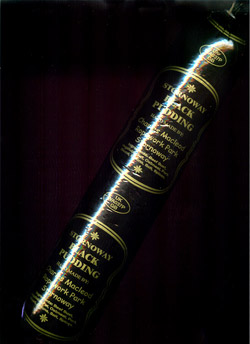
The serendipity origin of El pudín negro… recalls the earlier tertullia which resulted in the creation of El chaleco blanco. In July 1904 a group of writers and composers met in Madrid’s famous Café Inglés to celebrate the opening of the Trans-Siberian railway with consumption of vodka and sherry trifle. Much later on in the evening Chueca’s famous hat was pressed into use and filled with a random list of adjectives, common nouns and placenames. Arniches drew what he describes in his diary as “el paja corto” (“short straw”), but surprised his colleagues by coming up with this most witty and insouciant libretto within 24 hours. Though Arniches squarely based the composition of the pudding itself on hints taken from a sub-plot of Sir Walter Scott’s novel El enano negro (The Black Dwarf), the main lines of his plot are entirely original.
Despite its impeccable género ínfimo credentials, El pudín negro’s mix of British and typical madrileño characters, globe-trotting peregrination and pronounced vein of comedy fantasy are more likely to bring to mind Caballero’s ever-popular Los sobrinos del capitán Grant, though Torregrosa’s score is if anything more varied and entertaining. His regular compositional partner Valverde is credited with the idea of introducing the English music-hall song “Where did you get that Hat?” into the London pub scene, as a compliment to Chueca’s headpiece which had been – in a real sense – the inspiration behind the composition of the work.
 Scene 1 – Courtyard of a Madrid tenement
house… After a brief but lively Preludio
centred on a fandango version of the Scottish song “Scots Wa
Hae Wi' Wallace Bled” the curtain rises to reveal a tenement
courtyard in the heart of Cuatro Caminos. It is the night of the Verbena de
los Santos Inocentes, the most important midwinter festival in this
particular barrio (suburb) of Madrid, and the residents – who
include an émigré family of Scots herring-fishers – are
complaining of the cold as they prepare for the celebrations
(Coro:“ Más frío que
un lomo de merluza”).
Scene 1 – Courtyard of a Madrid tenement
house… After a brief but lively Preludio
centred on a fandango version of the Scottish song “Scots Wa
Hae Wi' Wallace Bled” the curtain rises to reveal a tenement
courtyard in the heart of Cuatro Caminos. It is the night of the Verbena de
los Santos Inocentes, the most important midwinter festival in this
particular barrio (suburb) of Madrid, and the residents – who
include an émigré family of Scots herring-fishers – are
complaining of the cold as they prepare for the celebrations
(Coro:“ Más frío que
un lomo de merluza”).
One of them, the portly and middle-aged sergeant of the civil guard Pando (spoken role), pleads with the vivacious local beauty Maris-Pipa (tiple-soprano) to allow him to take her to the verbena; but his conversation is so laced with feeble double-entendres that she laughs in his face, making clear that she would rather step out with one of the émigrés, the poor but honest Wee José (baritone), whose Spanish is too simple to rise to such ambiguities. The young man overhears her mocking praise but, good-hearted lad that he is, he decides that he will express his feeling by offering her the only gift he can – a large Black Pudding sent him as a Christmas Present by his agéd mother, back home in Stornoway on the beautiful Isle of Lewis.
He steps forward, producing his pudding with a flourish, but unluckily Pando mistakes it for a truncheon. Frightened, he blows his whistle and a trio of fellow guards (tenor, baritone, bass) arrive at the double (Escena y Coro: “¡Aquí estamos, que blandir nuestras porras!”) The tenement women take Wee José’s side, a hilarious fight ensues, and the guards retreat in the teeth of a full-scale Guajiras danced at full pelt.

A
typical Madrid tenement courtyard scene
Maris-Pipa realises that they are bound to return soon with reinforcements; and with the help of another admirer, the gentle but simple-minded Desecho (comic tenor), she smuggles Wee José out in a large crate which is to be taken to the river Manzanares for export to England, but at least safe from the vengeance of Pando. The ensuing Terceto: “¡Ayuda ... vamos a ponerlo en la caja!” is a brilliant “patter” number and one of the highlights of Torregrosa’s score. Maris-Pipa, left with nothing but her Black Pudding, feels guilt mixed with growing love for Wee José and in a touching Romanza:“Morcilla fatal” she pours out her grief. The scene ends in lively manner with the frustration of Pando as he returns with a whole platoon of guards, only to be faced with the mocking laughter of the women (Final:“¡Jejeje!”).
After a gentle Intermedio, featuring a ravishing instrumental dúo for bass tuba and piccolo, we reach…
 Scene 2 – Interior of a public house,
“El pato desagradable” (Dirty Duck) in the dock area of
London. Accompanied by the faithful Desecho, Maris-Pipa is earning
money by masquerading as a French cabaret singer whilst scouring London for her
lost love. The motley clientele of dockers, beefeaters (Yeomen of the
Guard) and upper-class debutantes is being entertained by the bearded poet
Alfred Lord Tennyson, who recites his latest Oda a una Botella de
Cerveza (“Ode to a Beer Bottle”) to grand approbation.
Maris-Pipa persuades the friendly Tabernero (pub landlord, bass) to let her
sing, and with Lord Tennyson at the piano she thrills them with the
once-scandalous Cuplés de Jack, a
quintessential género ínfimo number which
pertly suggests that every man would behave like Jack the Ripper if he were
given half a chance. The scandalous nature of this song was largely responsible
for the work’s stage ban under Franco.
Scene 2 – Interior of a public house,
“El pato desagradable” (Dirty Duck) in the dock area of
London. Accompanied by the faithful Desecho, Maris-Pipa is earning
money by masquerading as a French cabaret singer whilst scouring London for her
lost love. The motley clientele of dockers, beefeaters (Yeomen of the
Guard) and upper-class debutantes is being entertained by the bearded poet
Alfred Lord Tennyson, who recites his latest Oda a una Botella de
Cerveza (“Ode to a Beer Bottle”) to grand approbation.
Maris-Pipa persuades the friendly Tabernero (pub landlord, bass) to let her
sing, and with Lord Tennyson at the piano she thrills them with the
once-scandalous Cuplés de Jack, a
quintessential género ínfimo number which
pertly suggests that every man would behave like Jack the Ripper if he were
given half a chance. The scandalous nature of this song was largely responsible
for the work’s stage ban under Franco.
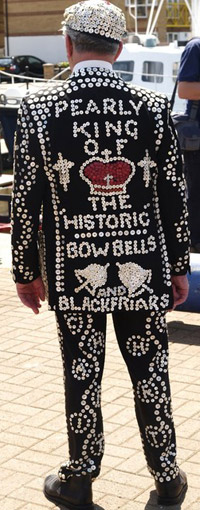
The pub crowd are still applauding loudly when a group of Pearly Kings burst in, led by the Alcalde (Mayor) of London – Pando in disguise, secretly tailing Maris-Pipa in order to track down his rival. They dance a rumbustious Seguidillas with the debutantes. The “Alcalde” soon wins Maris-Pipa’s trust, and when she produces the Black Pudding as her only clue he promises to help her find her lover. The sight of the fatal sausage elicits a cry from “Lord Tennyson”, who flinging off his beard throws himself onto Pando – in reality he is indeed Wee José, himself following Maris-Pipa to test her fidelity!
Once again the women take his side, and as the Pearly Kings retreat before the onslaught of the debutantes Desecho creates a distraction by grabbing Pando’s Mayorial sombrero de tres picos ( tricorne) and launching into the brilliant Pasodoble:“¿Where did you get that hat?”, a daringly contrapuntal ensemble in which everyone joins. Under cover of the culminating fugue, Maris-Pipa and Wee José slip out of the Dirty Duck towards a nearby paddle-steamer, the Balmoral. Pando realises all too late what’s afoot; and the curtain falls as the steamer sails off into the sunset with the Pearly Kings in hot pursuit.
 Scene 3 – Loch Ness, in
Scotland. After a maritime Escena de Baile (ballet)
of great musical charm, featuring such denizens of the Scottish deep as
lobsters, crabs and culminating with a Tanguillo danced by a
smoked haddock, the Balmoral looks set to be caught by the battleship
H.M.S. Indomitable captained by Pando; but as he raises his pistol to
shoot Wee José, a huge storm arises and the Loch Ness Monster
(“Nessie”) rises between the vessels. Pando aims at Nessie instead,
but when she sees Wee José brandish his Black Pudding the loyal monster
breaks the Indomitable in two with a single crack of her tail, to the
accompaniment of a lilting orchestral Vals:
“Tempestad del Mar”. Pando and the Pearly Kings are left
floating helplessly in the water as Nessie carries the lovers away on her back
to safety – and Stornoway!
Scene 3 – Loch Ness, in
Scotland. After a maritime Escena de Baile (ballet)
of great musical charm, featuring such denizens of the Scottish deep as
lobsters, crabs and culminating with a Tanguillo danced by a
smoked haddock, the Balmoral looks set to be caught by the battleship
H.M.S. Indomitable captained by Pando; but as he raises his pistol to
shoot Wee José, a huge storm arises and the Loch Ness Monster
(“Nessie”) rises between the vessels. Pando aims at Nessie instead,
but when she sees Wee José brandish his Black Pudding the loyal monster
breaks the Indomitable in two with a single crack of her tail, to the
accompaniment of a lilting orchestral Vals:
“Tempestad del Mar”. Pando and the Pearly Kings are left
floating helplessly in the water as Nessie carries the lovers away on her back
to safety – and Stornoway!
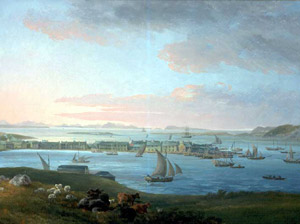 Final Scene – The village green of
Stornoway. The tartan-clad native Herring-Wives are resting lazily in
the sunshine under the Scottish palm trees, after a hard day’s pudding
making. They sing a lilting habanera Coro:
“Tome la carretera baja” (“You take the low
road…”) based on a once-popular Scottish tune. Accompanied by the
sound of authentic bagpipes (imported by Torregrosa specially for the premiere)
Wee José and Maris-Pipa are carried in on the shoulders of a brawny
Highland Regiment, holding aloft the sacred Stornoway Black Pudding which has
saved their lives. The boy’s Madre (mezzo-soprano) is about to bless
their union, when Pando and the Pearly Kings are dragged ashore by the natives
more dead than alive. Duly remorseful for his behaviour Pando forgives
everyone, the Herring-Wives embrace the Pearly Kings, and the zarzuela ends
– inevitably enough – with a bracing Chotis
(Schottische) which everyone joins, as the traditional botijo de
whisky is passed happily from hand to hand.
Final Scene – The village green of
Stornoway. The tartan-clad native Herring-Wives are resting lazily in
the sunshine under the Scottish palm trees, after a hard day’s pudding
making. They sing a lilting habanera Coro:
“Tome la carretera baja” (“You take the low
road…”) based on a once-popular Scottish tune. Accompanied by the
sound of authentic bagpipes (imported by Torregrosa specially for the premiere)
Wee José and Maris-Pipa are carried in on the shoulders of a brawny
Highland Regiment, holding aloft the sacred Stornoway Black Pudding which has
saved their lives. The boy’s Madre (mezzo-soprano) is about to bless
their union, when Pando and the Pearly Kings are dragged ashore by the natives
more dead than alive. Duly remorseful for his behaviour Pando forgives
everyone, the Herring-Wives embrace the Pearly Kings, and the zarzuela ends
– inevitably enough – with a bracing Chotis
(Schottische) which everyone joins, as the traditional botijo de
whisky is passed happily from hand to hand.