|
Teatro de la Zarzuela, 2006
La tabernera del
puerto
“Los
cantantes de Cantabreda”
Christopher Webber |

|
|
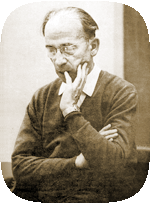
Pablo Sorozábal
in the recording
studio
|
It has been said, that a good
recording of Verdi’s Il Trovatore needs one, simple ingredient
– the four greatest singers in the world. La tabernera del
puerto is perhaps the zarzuela equivalent, except that in place of the
classic operatic quartet of soprano, mezzo-soprano, tenor and baritone
Sorozábal demands the conjunction (familiar from Arrieta’s
Marina, in many ways the work’s template) of lyric soprano,
tenor, baritone and basso profondo. In Act Two, these four must
negotiate the sequence of famous canciones and romanzas which stretch vocal
technique and interpretative power to the utmost, and it is no surprise that so
many Spanish singers have been drawn to record these roles. |
|
Given the Act Two sequence
and its many other vocal opportunities, little wonder that La
tabernera… has proved the most popular of Sorozábal’s
stage works on vinyl and CD, a fact to which the extensive (though by no means
exhaustive) discography in the Biblioteca Nacional testifies. But a good La
tabernera… on disc will not only be about great singing. The
salt-tang in the air of the mythical “Cantabreda” coast is
marvellously evoked by Sorozábal, in piquant, Debussyesque harmonies
combined with rumbustious Basque tunes and percussive, jazz rhythms, all
supporting an essentially Spanish lyricism. La tabernera… is
also amongst his most symphonically taut stage works, an advantage which can
make gramophone listening away from the stage an unusually satisfying
experience. Sorozábal’s orchestral imagination, a highly personal
mixture of dagger-sharp woodwind interventions, luscious string cantilenas and
impressionistic seascapes, comes across clearly even in relatively crude
recordings – although it must be said at once that La
tabernera… has been very fortunate in the recording studio.
|
|
1936 was certainly not the
best year to launch a new zarzuela, and it is no surprise that the onset of War
resulted in far fewer recordings of La tabernera… on 78 rpm
discs than might have been expected, given the huge success of its Barcelona
premiere. As we shall see, of the stellar quartet of singers – Conchita
Panadés, Faustino Arregui, Marcos Redondo and Aníbal Vela –
who sang on that famous night only Redondo and Vela have left any records of
the work, and Vela’s contribution is limited to his participation in the
Terceto No.2: “¡Qué días aquellos de la
juventud!”, one of a pair of numbers recorded under the composer for
the Odeón company at the time of the Barcelona run. The other, an
inestimable treasure, is Redondo’s Act Three Romanza No. 13:
“No te acerques”. A mere handful of recordings under the
composer and Maestro Pascual Godés followed, and it was not until 1958
– well into the age of LP – that Sorozábal was able to
record his most popular zarzuela in its musical entirety, for the Hispavox
company in Madrid. Two more, equally complete recordings were to follow under
the composer’s baton, and between them these three LP sets provide an
authentic benchmark by which later recordings of La tabernera del
puerto on CD and DVD have been – and will continue to be –
judged. |
| |
Complete
Recordings
|
|

Alfredo Kraus
|
There is often a unique
electricity to premiere recordings, and the 1958 Hispavox LP set is no
exception. Sorozábal the conductor is as decisive as Sorozábal
the composer. His aphoristic, brisk, vigorous podium style ensures an
energetic, dramatically taut performance from the Orquesta de Conciertos de
Madrid which on the other hand loses nothing in lyric fervour or flexibility.
He invariably knew how to get the best out of his performers, and in 1958 he
had a specially promising cast with whom to work. Zaragoza’s favourite
daughter Pilar Lorengar – then in her youthful prime – might have
been expected to play the title role, but in her absence Leda Barclay makes a
good alternative. Although she occasional struggles to be heard over the
orchestra in the more heavily scored passages, such as the Act Three storm
scene, Barclay’s technically well-produced soprano with its pronounced
vibrato and warm tone provides much pleasure, especially in her showpiece
No.6b: “En un país de fabula vivía un viejo
artista…”. In the two romantic dúos she rather pales
by the side of her Leandro, Alfredo Kraus in one of his first complete zarzuela
recordings. His virile ardour, glorious stream of spinto tone and
lapidary diction sound as astounding now as they must have seemed then, and his
Romanza No.8 “¡No puede ser! Esa mujer es
buena…” is, musically speaking, the outstanding highlight of
the set. His characterisation of the ardent young fisherman is proud, even
occasionally cold-eyed, steel-strong throughout. |
|

Renato
Cesari
|
The more one listens to
La tabernera del puerto, the more apparent it becomes that the
particular quality of a recorded performances is defined by the singer in the
pivotal role of Juan de Eguía, that pirate-colossus who bestrides the
plot, as fascinating as he is repellent. In 1958 the Argentine baritone Renato
Cesari took the role. He was a great favourite of Sorozábal’s in
the studio, and it is easy to hear why. His was a distinctively grainy voice,
with an almost tenorial high tesitura “croon” comparable to his
contemporary, Luis Sagi-Vela, but possessing a firmer, quintessentially
masculine middle register. Though his powers of characterisation were
generalised, his vocal control was stupendous, as witness the effortless way he
takes an optional, pianissimo High G at the end of the
Terceto-habanera in Act One. Cesari is every inch the Gentleman, all sensitive
vocal nuance even where a degree of brute force seems to be called for, and so
his characterisation of that catchy piece of “political
incorrectness”, No. 6c: “La mujer, de los quince a los
veinte…”, is all charm and little bravado. His old companion,
the drunken English sailor Simpson (no national stereotypes, please!) is
memorably played by Jorge Algorta, the first of a series of marvellously firm
Spanish basses in the role, with a consistent, rounded timbre sounding like
well-oiled English oak. |
|

Enriqueta Serrano
|
The composer’s wife
Enriqueta Serrano, in one of the last records before her untimely death from
cancer, takes the role of Abel, but her matronly tone and very feminine vocal
persona are not ideal in this tricky “breeches” role. Luisa
Espinosa and José Marín make a suitably vulgar comedy pair, and
there is a pleasant, subtly comedic Ripalda from Enrique Fuentes. The mono
recording is sweet on the ear, and most beautifully balanced for its time
– an advantage the remastered edition from EMI (2000) captures well. The
somnolent, negro murmurs in Simpson’s Tango have a haunting, distant
ambience; the La Mer-like palette of woodwind arpeggios and magical,
muted trumpets in the Act Three dúo and storm scene come across with
great immediacy. Unlike its previous CD incarnation, this latest version also
has the advantage of fitting the whole recording onto one disc. All in all,
with its sprinkling of dialogue in addition to the passages spoken over music,
the 1958 version occupies a very special niche of honour. |
|

Manuel Ausensi
|
The protagonist in
Sorozábal’s 1968 stereo “remake” for Columbia-Alhambra
is without question the Juan de Eguía of Manuel Ausensi. Here we have
the brutal, coarse pirate to the life. He swaggers through “Chibiri,
chibiri”, before welling over with sentimental self-pity in his Act
Three Romanza. This is not a vocally unblemished performance – Ausensi
often sings under the note in alt, and his ample tone can sometimes
sound hectoring at forte – but the characterisation is always
vivid. Victor de Narke packs a punch as Simpson, relatively lightweight but
sharply pointed verbally in “Despierta negra”. Alicia de
la Victoria’s Abel is a strong asset, her rich but vibrato-free soprano
reminiscent of a boy alto; the comedy pair of Carmen Rodríguez
Aragón and Eduardo Fuentes have an amusingly aristocratic air about
them; Ramón Regidor’s Ripalda is neat and funny. Juan Manuel Ariza
is strong and youthful enough in tone and timbre to make an effective Leandro;
but despite this sympathetic personality his musical phasing is often
four-square, especially in “No puede ser”, and he is
audibly strained above the stave. He is, in the wrong sense, “all at
sea” in the Act Three dúo, and this remains a performance which
one wishes to like more than one actually does. |
|

Ana Higueras
Aragón
|
His Marola is an excellent,
young singer caught at the start of her career – Ana Higueras
Aragón. She captures well the moment where a “head in the
clouds” girl turns into a woman, and makes a good foil to set against
Ausensi’s weather-beaten father. And though a lack of technical
perfection surfaces occasionally in her performance, she sings the sensual
first phrase of “Marinero vete a la mar” with adorable
simplicity, and her spoken confession to Leandro ( No. 8 bis. “Yo soy
de un puerto lejano…” ) is movingly acted. She and Ariza,
however, do not blend well together stylistically; and paradoxically the stereo
recording is less clear (particularly in its antiquated, current BMG CD
transfer) than the mono Hispavox from a decade before. There is some
disconcerting spotlighting of instrumental details, for example the harp in the
No.2 Terceto, and the orchestral playing from the Orquesta Sinfónica can
be rough. Columbia-Alhambra included a greater quantity of dialogue, but it is
heavily done. The composer/conductor himself is on gruff form, too, and
altogether this is a performance valuable for individual contributions –
most notably Ausensi’s – rather than conveying the overall sweep
and beauty of Sorozábal’s conception. |
|

Isabel Penagos
|
The 1971 Zafiro recording is
a very different proposition. In what was to prove one of his last recordings,
Sorozábal revealed his score in a fresh light, taking significantly
broader tempi in the love music and generating a fearsome energy elsewhere
which was quite amazing for a man in his mid 70’s. As ever, he adapted
his approach to his cast, notably more “operatic” in weight than in
the earlier LP sets. This is especially true of Isabel Penagos, whose Marola is
a size larger than any other singer’s. The Act One Final No.5:
“ ¡Aquí está la
culpable!… ” is less comedic, much more a dangerous
confrontation with the port’s women than usual, and her sumptuously
smooth legato line and creamy-rich tone in “ En un
país de fábula vivía un viejo artista…
” give this great vocal showpiece a rare sensuality. With Penagos,
we could be on the edge of tragedy throughout, which makes for powerfully
moving effect in her encounters with the straightforward, bright and
strong-muscled Leandro of Julián Molina. Their voices blend particularly
well in the Act One dúo, where they sustain Sorozábal’s
broad tempo with unwavering breath control, vocal opulence and moving dramatic
power. This is great singing; and although elsewhere Molina can become
lachrymose, and his attention to detailed phrasing does not rival Alfredo
Kraus, he and Penagos provide a memorable match. |
|

Pedro
Farrés
|
More controversial is the
highly distinctive Juan de Eguía of the Catalan Pedro Farrés. His
fast vibrato and dark-grained, monolithic baritone are perhaps an acquired
taste, but he manages to control its immense size sufficiently to paint an
unforgettable portrait of a villain whose soul is shot through with poetry. If
“Chíbiri, chíbiri” is surprisingly dark and
dangerous, “No te acerques” is a very different matter.
Again, Sorozábal relaxes the tempo, and Farrés responds with an
outpouring of heartfelt grief of unforgettable power. This is a tragic figure,
lost in his own dark world. Julio Catania’s Simpson is equally
impressive, a portrait worthy of Velasquez. He sings his Tango with saturnine
depth and evenness of tone, effortlessly conveying a sense of righteous anger
at the plight of the negro sailors. Meanwhile the “ Mississippi
tom-toms” pound out their highly hypnotic, rhythmic drumming
accompaniment. Alicia de la Victoria repeats her fine Abel, here lighter and
more gently melancholic than in 1968. It might be felt that Catania and
Farrés are not contrasted enough in vocal character; the stereo is
comparatively crude, the orchestral playing is not always subtle, chorus and
soloists are placed very forward in the sound picture. However, these are small
prices to pay for such committed, stirring music making. As the
composer-conductor’s “Final Testament” to his beloved Marola,
this Zafiro set is a remarkable document which demands immediate restoration to
the CD catalogue. |
|

María Bayo
|
The 1996 Auvidis Valois
recording is the first complete set to grace the CD era. Víctor Pablo
Pérez may not aim for the fierce energy and theatricality which the
composer applied to his own recordings, but he is a cultivated musician with a
finely-tuned ear for orchestral balance. Such details as
Sorozábal’s woodwind imitation of Abel’s tinny
accordion-playing come over most evocatively, and the delicate French and
Basque components of the score are clearly delineated. María Bayo is at
her brilliant best as Marola, combining languorous sensuality and coloratura
brilliance (in the passage work of “En un país de
fabula”) with that sharp intelligence uniquely her own. The comedy
Terceto No.9: “Marola resuena en el oído” is a
special joy, where she is well supported by Isabel Monar’s light and
lucid Abel, and Emilio Sánchez’s witty Ripalda. Enrique
Baquerizo’s firm Simpson is yet another triumph for the school of Spanish
bass singing, in a role well served in every performance. He has the
self-confidence to end his Tango quietly on a sustained middle B flat, rather
than going for the top E flat “big finish” preferred by his
competitors, and the effect is intensely arresting. Maybe the composer should
have trusted his own score better! |
|
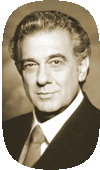
Plácido Domingo
|
Plácido Domingo is
Leandro. In the late 1990’s his voice had lost some of its force, but
little of its beauty and evenness throughout the range – nor does he
employ any of the baritonal colours which have re-asserted themselves in his
work today. All this makes him a Leandro close to the ideal. Of course,
“No puede ser” has become his vocal Calling Card around
the world, but of his many recordings of the famous romanza none is more
thrilling than this, and hearing it in its dramatic context adds poignancy. He
and Bayo combine well in the dúos, as do the comedy couple Rosa
María Ysás and Jesús Castejon. Their No.3:
“ ¡Ven aquí, camastrón!…
” has a playful, ribald quality which is endearing. Juan Pons sings
Juan de Eguía with bronzed and beautiful tone throughout, and pays
scrupulous attention to verbal details. If his characterisation seems
self-contained, that may be more to do with the overall feeling of a
performance which is stronger on good taste than it is on passion. But with
such faultless orchestral playing and choral singing – not to mention the
inestimable benefit of a truly modern, dynamic recording – this is likely
to remain the “reference version” of Sorozábal’s
score. Although it is currently deleted, the new owners of the Auvidis Valois
label, Naïve, are gradually re-introducing their zarzuela recordings to
the catalogue and the frustrating situation should not continue for too long.
|
| |
DVD
|
|

Elisa Vélez
|
No.8 in José
María Damunt’s Zarzuelas inolvidables was recorded live
at the 2002 Festival de Ópera de Las Palmas de Gran Canaria. Although
the settings are minimal and the production very basic, there is much to admire
about the singing, not least Elisa Vélez’s bright, perfectly tuned
soprano in the title role and Antonio Adame’s stylish Leandro. Elu
Arroyo’s Simpson is also strong, and although Vicente Lacárcel is
prone to some woolly singing above the stave, he makes a credible, bear-like
Juan de Eguía. Additional attractions are a pretty Abel from
María Luisa Pönicke, and an outrageously gay Ripalda from Airam
Ramírez. José María Damunt controls his vocal and
orchestral forces with a steady hand – although it is a pity that he
supplements the masculine chorus of sleeping negroes in Simpson’s Tango
with some high female ones. The effect is incongruously angelic and very far
from what the composer had in mind. The DVD is crudely produced, with no
detailed chapter markings and irritating “musical fragments”
between the three acts; but the score and libretto are performed absolutely
complete in what is at least an enjoyable entertainment. |
| |
Fragmentary
Excerpts
|
|

Marcos Redondo
|
The fragments recorded on 78
r.p.m. shellac discs in the pre-LP era by Marcos Redondo are of the highest
value. Juan de Eguía was written for him, and his reading of
“No te acerques” demonstrates the astounding technical
control and interpretative powers of a great singer in his prime. In the
Tristanesque vocalise at the beginning of the truncated Act One terceto, sung
with the original Simpson and Verdier (Aníbal Vela and Antonio Ripoll)
he takes us back in time and place to “when the world was
young” most magically. Unfortunately Redondo’s sole recording of
“Chibiri, chibiri” – a later addition to the score
written at his specific request after the Barcelona run – was made in the
1950’s, when the singer no longer had the vocal flexibility to do himself
full justice. |
| |
Of those other early
recordings, the 1936 readings of the love-dúos and “En un
país de fabula” by María Espinalt with Vicente
Simón show these artists a little way below their best. The version of
“No puede ser” found on Blue Moon BMCD 7518 – a very
useful compilation of many of these fragments – is wrongly
attributed to Simón, being in fact a later recording made in Barcelona
by the little-known Asturian singer Marcelino del Llano, who went on to sing in
the premieres of Black el payaso and Guerrero’s Loza
Lozana in the early 1940’s. He demonstrates a strong, reedy but
unwieldy tenor with effortful, strained high notes. The transfer on Aria 1033
gets these details right, and sounds better. More worthwhile are
Sorozábal’s 1943 Barcelona recordings for Columbia: a vibrant,
graceful “Chíbiri, chíbiri” from Antonio
Medio; a sonorous, mellow (and sadly truncated) “Despierta
negro” from Manuel Gas; and a pointed, energetic performance of the
Dúo Cómico featuring Enriqueta Serrano and Manuel Alares, who are
joined for the Act Two terceto by Pepita Embil, the mother of Plácido
Domingo, whose velvet-rich Marola – equally sumptuous in her
“En un país de fabula…” – makes us
wish she had recorded more of the title role. |
| |
This brings us to the most
recorded tenor song in the entire zarzuela repertoire, “No puede
ser”, which Domingo himself has made famous in countless galas
líricas around the world. Of his many live and studio versions on
CD and DVD (many from Three Tenors concerts) the EMI Classics 49148
displays him at his 1988 vocal zenith, but even this does not surpass the
dramatic intensity of his reading in the complete Auvidis performance.
Sorozábal notoriously claimed that he never wanted tenors to sing
“No puede ser” for him at auditions, as it was so well
written for the voice that it always made its effect; but in spite of that, it
still proves difficult for singers to hit the mark on disc! Amongst José
Carreras’s recordings, the 1994 studio version with the English Chamber
Orchestra under Enrique Ricci on the Erato CD entitled Passion of
Spain is both heartfelt and moving. What is impressive, is the skill with
which the artist uses textual nuance to cover any purely vocal limitations.
|
| |
Alfredo Kraus made several
stand-alone versions of “No puede ser” at various stages
of his career, all of them marked by his inimitably proud vocal personality and
fastidious craftsmanship. The most affecting and interesting of them is the
very earliest, recorded in 1958 at about the same time as his complete
recording, and with the same orchestra and conductor (Orquesta de Conciertos de
Madrid, d. Sorozábal.) This version, very clearly a different
“take” from the highly-charged reading in the complete LP set, is
subtly more reflective, less virtuosic, more relaxed – and all the more
effective for that. Kraus employs a wider palette of tone colours here than in
his other recordings, without yielding anything in cutting edge or elegance of
line. This recording, from the indispensable Romanzas y dúos de
Zarzuela (CDZ 7 62756 2) is a gramophone classic. |
|

Vicente Simón
|
Of the rest, Pedro
Lavirgen’s 1963 Hispavox record (with the Orquesta de Conciertos de
Madrid under the composer) is viscerally exciting without necessarily
demonstrating fully the singer’s potential for colour or subtlety.
Vicente Simón’s sensitive delicacy is well represented by his 1936
78 rpm Odeón Barcelona recording. Vincenzo la Schola’s live
Bologna recital with piano accompaniment (Bongiovanni GB25202, 1996) shows off
his plangent, flexible tenor to fine effect. Otherwise, there exists an
intriguing 1958 recording of the orchestral Interludio from Act Three in
Pasodobles y marchas de Pablo Sorozábal, a life-enhancing
collection from the composer and his Orquesta de Conciertos de Madrid (Hispavox
HH 10476 and many reissues). Punchy, mischievous and electrically tense, this
exhilarating version is a summation of Sorozábal’s energetic gifts
as composer and conductor. |
© 2006 Teatro
de la Zarzuela, Madrid & Christopher Webber
"tabernera" CD digest
(ref.)
cd
magazine
zarzuela
homepage |
 Introduction