DVD roundup
from Christopher Webber
 Jarvis
Conservatoire
Madrileña Bonita
Esto es
Zarzuela
Jarvis
Conservatoire
Madrileña Bonita
Esto es
Zarzuela
With studio recording apparently a pearl beyond the price of today's CD producers, La Zarzuela finds herself decked in the same paste jewels as her elder sister La Opera, with live performance on DVD becoming the chosen format for new releases. Whatever the drawbacks, the newer medium does allow us to see as well as hear how our current crop of performers measures up against the classics. Often we hear them in very good sound too, albeit peppered with stage bumps and executive imperfections which may grate on repetition. But then music DVD is more about capturing the instant, less about savouring performances down the years. How many DVD releases will turn out to be “keepers” to share the company of those treasured sound-only versions? Ask me in twenty years!
Jarvis
Conservatoire
Website: jarvisconservatory.com
Email:
info@jarvisconservatory.com
The
performing tradition at Napa in California, where a zarzuela is staged each
summer to admirable musical and theatrical standards, is vividly conveyed in
the recent crop of DVDs. All are from live performances, some seamlessly
transferred from earlier VHS releases. The Jarvis Conservatoire productions are
in traditional style and bilingual, with spoken dialogue in English and musical
numbers in Spanish. Given the well-translated subtitles optionally provided
this solution works pretty well. Choral, orchestral and - especially - dance
contributions are at a consistently high level, and especially for starved
aficionados in the USA the Jarvis archive provides a very satisfying
feast.
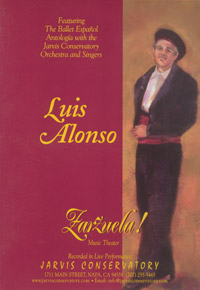
[ Luis Alonso ] [ Anthology
2004 ] [ La chulapona ]
[ Doña Francisquita ] [ La gran
vía ] [ La dolorosa
]


|
|
MADRILEÑA BONITA
|

Well-staged, well-prepared musically and well-presented for DVD, Madrileña Bonita is surely the most satisfying thing of its kind to emerge since the days of Tamayo's famous Antología in the 1980's and 90's. Unlike many such shows, it centres almost exclusively on the talent of one artist, and María José Montiel is well up to the challenge. Her intelligence and strong personality are readily conveyed, her chocolate-rich mezzo is in great form throughout. In romanzas such as “Cuando está tan hondo” (El barquillero) which she was born to sing, musical and vocal allure are in perfect equilibrium. Even where there's a slight mismatch between musical needs and vocal nature, as with “De España vengo” , Montiel's artistry gains the day. This is a star performance: ten seconds sampled from either that Chapí romanza or Trini's “Recuerdas aquella tarde” from Adios a la Bohemia should convince anyone of that.
Montiel sings Trini's number draped over film actor Fernando Guillén, the evening's dignified MC. His delivery of the linking script stays just the right side of solemn, though the idea that the evening is a nostalgic “tribute to the women of Madrid ” is carried through more in half-glimpsed visual projections than the choice of music, a pleasant selection taken mostly from the usual gala suspects. Chorus and dance elements ring the changes nicely, orchestral execution is smart, although Pascual Osa's tempi can veer into eccentricity. Costuming is opulent, lighting is atmospheric and sophisticated, so there's something to enchant eye as well as ear.
The DVD is well produced, sound and image both rich and clear. It's an inestimable advantage to have good English subtitles available. Best bonus of all, the Spanish-only booklet is generously illustrated not only with stills from the show, but also rare photographs of those most famous Madrid women, the zarzuela sopranos of the Golden age. These, and the accompanying texts, are provided by Emilio García Carretero, historian of the Teatro Real and no mean zarzuela performer himself. Short but perfectly formed, this is one zarzuela gala which nobody should miss.
|
|
ESTO ES ZARZUELA |

Another anthology, which takes a more conservative tack than the Teatro Real's theme-plus-star approach. Perhaps “That was Zarzuela” might reflect the atmosphere more accurately; but in fairness Producciones Guridi go for sensible sequences from a small number of popular zarzuelas, mixing solos, duets, choruses and danced intermedios enjoyably. There's a good selection from La layenda del beso; and some rarer items, too, such as the hero's romanza from Black el Payaso - although Luis Cansino's energetic rendition can't disguise that this is one of the weaker numbers from that marvellous score. Francisco Matilla's hand on the directorial tiller plus lively choreography ensures focus is maintained, even where lack of rehearsal time results in some generalised acting - not least from the distinguished male soloists, of whom Salvador Baladez comes off best as a vertiginously deboshed Caballero from La gran vía.
Guadalupe Sánchez and Pilar Moro take the lion's share of the female roles to good effect, but it is the guest appearance of Bulgarian soprano Svetla Krasteva in “Me llaman la primorosa” (common to both anthologies - and incidentally to the Jarvis 2004 concert as well) which really lights up the house. With workmanlike support from the Vives Orchestra and tight tempi from Pascual Ortega, there's plenty here to entertain.
The disc itself is serviceably produced, though some of the menu still shots should have been de-interlaced to avoid an off-putting visual pulse on my various players. The sound, which favours orchestra at the expense of distant-sounding soloists, is not ideal; nor was the side-angle camera colour-matched with the rest, which might have the viewer reaching fruitlessly for the colour control. Given Producciones Guridi's shoestring resources and high ideals for La Zarzuela, this is a creditable first issue.
© Christopher Webber 2005