|
|
Carlo Del Monte tenor 25 January 1923¹ – 15 September 2000 The fine Catalan tenor Carlo Del Monte died on September 15th in Mexico City. He was born Helenio Barjau Vallmitjana at La Sagrera, San Andrés, near Barcelona on 25th January 1923¹ , a son of the militant socialist Felipe Barjau. |
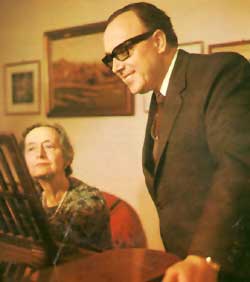
He worked and paid his way through the Mexico City Conservatory, beginning his career in comprimario roles at the Teatro del Palacio de Bellas Artes. As Arturo in Lucia de Lammermoor he played opposite Callas and Di Stefano. Leading roles soon followed at that theatre, where he enjoyed a particular triumph as Manrico in Il Trovatore. Championed by his compatriot Victoria de los Ángeles, he obtained a Carnegie Hall audition in New York which led to further study at the Escola La Scala, Milan; engagements in Paris; and his earliest and most celebrated recordings with de los Ángeles for EMI - a much-praised Rinunccio in the classic Gianni Schicchi with Gobbi, under Gabriele Santini (1958); and as Alfredo in the recently reissued 1959 La Traviata with Los Ángeles and Mario Sereni, conducted by Tullio Serafin. One of his more unusual engagements around this time was to sing Jacopo in I Due Foscari at the Wexford Festival conducted by Sir John Barbirolli.
Returning to Mexico after a serious eye operation in 1959, he later revisited Barcelona - though he never sang in the famous Teatro Liceu, due to a ban there on Republican performers. It was in Barcelona, however, that he perfected his vocal technique in fresh studies with the soprano Conchita Badía, first singer of La Dolorosa on record and also Montserrat Caballé's teacher. Later opera roles in Europe and Mexico included The Duke in Rigoletto, Hoffmann, Pinkerton, and Rudolfo in La Boheme.
He sang little if any zarzuela on stage, but the form was certainly important to his recording career. Indeed, his working situation in Spain was eased during the 1960's by a contract to record a series of zarzuela film soundtracks under Torroba for EMI-Hispavox, for which actors played the roles onscreen. These included the memorable versions of El huésped del sevillano, El caserío and Maruxa which are still available on EMI-Hispavox CD; together with recordings of Luisa Fernanda, Bohemios, Gigantes y cabezudos and El joven piloto (by Tellería) which are not, though Bohemios is at least available on video.
Amongst his later recordings was one for Philips, as part of a large team of soloists in a Zarzuela Anthology under the unlikely but highly galvanic baton of Igor Markevich (1967). In 1968 he finally made his debut at the Teatro de la Zarzuela in Madrid, in Escudero's Basque opera Zigor, another Spanish work he recorded. By the end of 1969 his voice was showing signs of wear, and after 1970 he retired to Mexico City from which time his singing appearances were few.
With its fast, tight vibrato, its consistency and richness throughout the range, and its focussed emotional power Del Monte's voice is perhaps comparable in some ways to Carlo Bergonzi. But the sound is always unmistakably his own, and his zarzuela recordings - pre-eminently the intensely moving El caserío - are a legacy fully worthy to stand beside the better-known opera recordings, fine mementos of a musical and highly distinctive singer.
[ Thanks to Erick Zermeño Morales for much of the above information. Señor Zermeño Morales writes of the first time he met and interviewed Carlo Del Monte some years ago - "He said to me, 'when the day finally comes that I must die it won't matter, because I will still be singing in heaven'." ]
¹ Note: 1923 is the year given by the singer himself and his family to Sr. Zermeño Morales. The reference books give 1921.
© Christopher Webber 2000